Tutorial 1: Conceptual Overveiw
What is an indicator?
An indicator is a measurable sign that tells us about the performance of something larger that we care about but cannot directly observe or easily measure.
Think of it like this: You cannot directly measure how “healthy” you are by looking in a mirror, but your doctor can check specific indicators like your blood pressure, heart rate, and cholesterol levels. Each of these measurements gives insight into your overall health status. Similarly,
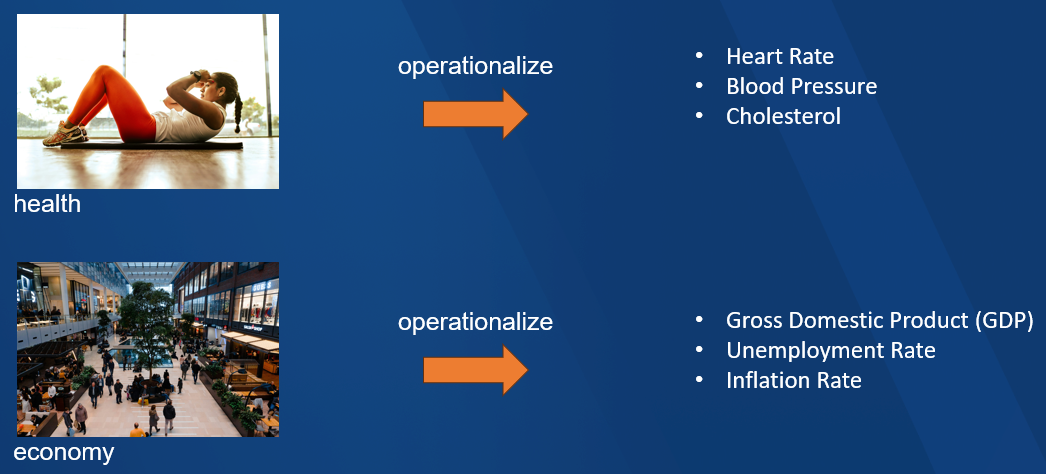
Indicators help us:
- Turn abstract concepts into concrete measurements
- Track progress over time
- Identify problems before they become critical
- Make informed decisions based on evidence
- Communicate complex situations in simple terms
Just like we need indicators of “health” to understand how healthy we are, we need indicators of “college excellence” to understand how well we are doing or how well we are living our mission and values and making progress toward our vision.
How did we select our College Excellence Indicators?
Our Guiding Philosophy: Mission-Driven Measurement
Our College Excellence Indicators represent a comprehensive framework that transforms our mission into measurable metrics. Our indicators ensure the college stays focused on what matters most to our students and community.
“What gets measured gets managed.” –Peter Drucker
Three Foundational Frameworks
1. Community College Student Success 3.0: Defining Success with the End in Mind
Community college student success has evolved through three distinct phases, each building on the previous while expanding our definition of what truly matters for students (Aspen Institute College Excellence Program, 2017; Wyner, 2014).1
Student Success 1.0: Access (Historical Focus) The original mission of community colleges centered on providing college education to those who might not otherwise be able to attend college. Success was measured primarily by who could get in the door—removing barriers and opening opportunities for first-generation college students, working adults, and those seeking affordable higher education options.
Student Success 2.0: Access + Completion (Early 2000s) As the field matured, we recognized that access alone wasn’t enough. The focus expanded to include completion—ensuring students not only enrolled but actually finished their programs. This era brought attention to completion rates, time-to-degree, and retention metrics.
Student Success 3.0: Post-Completion Outcomes (Current Approach) Today, we understand that student success must be defined with the end in mind. While access and completion remain important, they are insufficient measures of true success because:
- Students don’t aim to simply “complete”—they have life and career goals beyond graduation
- Not all degrees are equal in terms of post-graduation opportunities
- Some credentials may have limited independent value in the job market
- Transfer students need to successfully complete bachelor’s degrees, not just transfer
Our 3.0 Definition: Student success means students achieve their post-college goals, whether that’s: - Employment in jobs with family-sustaining wages - Successful completion of a bachelor’s degree after transfer - Career advancement in their chosen field
This approach requires us to track what happens to students after they leave our institution, ensuring our programs and services truly prepare them for long-term success rather than just short-term credential attainment.
2. Leading, Lagging, and Post-Completion Indicators: A Complete Picture
Effective measurement requires looking at performance through three different lenses, each providing unique insights that work together to create a comprehensive understanding of our institutional effectiveness.
Leading Indicators: Early Warning Signs Leading indicators are like the check engine light in your car—they signal potential problems before they become critical, giving us time to intervene and change course. These metrics help us predict future student success and identify students who may need additional support.
Examples include: - First-year course success rates - First-year credit accumulation (are students taking enough units?) - Education plan completion rates (do students have a clear path?) - Gateway course completion (are students completing transfer-level math and English?)
Why leading indicators matter: If we only looked at graduation rates, we’d be like a doctor who only checks if patients are alive or dead—by then it’s too late to intervene. Leading indicators let us provide support while students can still benefit from it.
Lagging Indicators: What We Accomplished Lagging indicators show us the final outcomes for students who have completed their journey at our institution. These are the traditional metrics that tell us how well we served the students who made it through our programs.
Examples include: - 3-year graduation rates - Transfer rates to four-year institutions - Time-to-credential - Licensure exam pass rates
Why lagging indicators matter: These metrics tell us definitively whether our programs and services are working. They’re essential for accountability and help us understand our impact on students who complete their time with us.
Post-Completion Indicators: The Ultimate Test Post-completion indicators reveal whether our students achieved their life goals after leaving our institution. This is where we discover if our education truly prepared them for success in the real world.
Examples include: - Employment rates and median earnings of graduates - Bachelor’s degree completion rates for transfer students - GPA performance after transfer compared to native four-year students
Why post-completion indicators matter: These metrics answer the ultimate question: “Did we actually prepare our students for success in life?” A high graduation rate means little if graduates can’t find meaningful employment or struggle after transferring.
How They Work Together Think of these three types of indicators as providing past, present, and future insights: - Leading indicators help us predict and prevent future problems - Lagging indicators help us understand our current effectiveness - Post-completion indicators help us evaluate our long-term impact
This comprehensive approach ensures we can both improve our current practices and validate that our efforts truly serve our students’ ultimate goals.
3. Two Dimensions of Excellence: Student Success + Institutional Health
While student success is the heart of our mission, measuring excellence through student outcomes alone provides an incomplete picture. True institutional excellence requires two complementary dimensions that work together to ensure both immediate impact and long-term sustainability.
Dimension 1: Equitable Student Success This dimension focuses on student outcomes and progress across six critical domains: Access, Teaching & Learning, Completion, Transfer, Workforce, and Equity. These metrics answer the question: “Are our students succeeding and thriving?”
Dimension 2: Institutional Well-Being This dimension focuses on organizational health and the quality of our collective experience as a learning community. These metrics answer the question: “Are we creating sustainable conditions that support ongoing student success?”
Why Both Dimensions Matter
The Sustainability Problem: Imagine a college that achieves impressive graduation rates by overworking faculty, burning out staff, and creating a toxic campus environment. While student outcomes might look good in the short term, this approach is unsustainable and will eventually undermine the very success it appears to create.
The Hidden Dysfunction Risk: Strong student outcomes can mask organizational problems that threaten long-term effectiveness: - High employee turnover that disrupts program continuity - Poor campus climate that affects teaching quality - Weak partnerships that limit student opportunities - Leadership gaps that prevent innovation and adaptation
The Holistic Excellence Approach: By measuring both student success and institutional well-being, we ensure that: - Our success is sustainable - We’re not achieving student outcomes through practices that will eventually fail - We’re building capacity - Strong institutional health enables us to serve more students better over time - We’re creating positive experiences - Students learn better in environments where employees are engaged and supported - We’re future-ready - Healthy institutions adapt better to changing student needs and external challenges
This dual focus ensures we’re not just achieving good numbers today, but building an institution that can consistently deliver excellence for students, employees, and the community we serve.
Our College Excellence Framework
Equitable Student Success: Six Critical Domains
Our framework includes six interconnected domains, adapted from the Aspen Institute’s College Excellence model:
Access Ensure high and equitable levels of enrollment, including in programs that lead to post-graduation success. If students can’t access our programs or are steered into pathways that are unlikely to lead to high opportunity, none of our other efforts matter.
Teaching & Learning Students learn effectively in courses and programs of study. A credential without learning is just expensive paper. Strong teaching and learning practices ensure that time spent in our classrooms translates into real capability and confidence.
Completion Students earn a degree or other credentials that have value in their lives after college. Starting college is important, but finishing with something valuable is what changes lives. We measure not just who graduates, but whether their credentials lead to better futures.
Transfer Students who begin at community college intending to earn a bachelor’s degree do so after transferring. For many students, we’re the first step in a longer educational journey. Our success isn’t complete unless we effectively prepare them for the next phase and they achieve their ultimate educational goals.
Workforce Students are well prepared for good jobs and rewarding careers. Many students come to us seeking better economic prospects. If our programs don’t lead to jobs with livable wages, we’ve failed to deliver on our promise of social mobility.
Equity Students of color and from low-income or other disadvantaged backgrounds achieve high and equitable levels of success in each part of this framework. Excellence that only works for some students isn’t true excellence. Equity ensures that our mission of access and opportunity is real for all students, not just those who already have advantages.
By monitoring all six domains simultaneously, we can identify both strengths to celebrate and gaps that need attention, ensuring that our success is both comprehensive and sustainable.
Institutional Well-Being: Four Essential Areas
Student success alone doesn’t tell the complete story of institutional excellence. We also need organizational conditions that make student success sustainable over time. Our Institutional Well-Being framework evaluates the health of our community through four essential areas:
Student Sense of Belonging Ensure students feel a sense of belonging and community. When students feel they belong, they’re more likely to persist, engage deeply in learning, and succeed academically. A strong sense of belonging creates the social and emotional foundation that supports all other student success efforts.
Campus Climate How employees perceive and experience their work. Faculty and staff who feel valued, supported, and engaged create better learning environments for students. Poor campus climate leads to turnover, burnout, and inconsistent student experiences, ultimately undermining our ability to serve students effectively.
Partnership/Fundraising Institution’s ability to develop strategic external relationships and generate financial support. Strong community partnerships create internship opportunities, job placement pathways, and program alignment with regional needs. Successful fundraising provides resources that enhance student services, facilities, and programs beyond what state funding alone can provide.
Leadership Capacity Institution’s ability to develop and support effective leadership. Strong leadership at all levels—from department chairs to executive team—drives innovation, manages change effectively, and maintains focus on student success. Leadership capacity ensures institutional resilience and continuous improvement.
How These Connect to Our Strategic Priorities
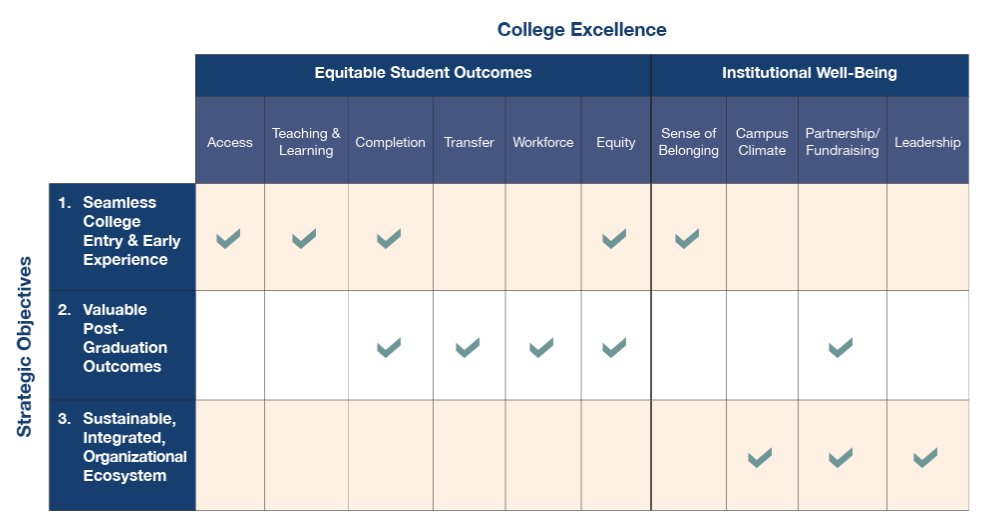
These metrics do not exist in a vacuum. The three objectives in the college’s current strategic plan (Strategic Educational Continuity Plan) map to several facets of the College’s Excellence Indicators. For example, Objective 1 (Seamless College Entry & Early Experience) maps to Access, Teaching & Learning, Completing, and Equity, as well as Sense of Belonging metrics. In this way, we ensure that the strategic objectives advances the ultimate outcomes that reflect the college’s mission and vision.
Footnotes
Wyner, J. S. (2014). What excellent community colleges do: Preparing all students for success. Harvard Education Press. Aspen Institute College Excellence Program. (2017). Leading for community college excellence: Curricular resources. Available at: https://collegeexcellencecurriculum.aspeninstitute.org/module/defining-student-success/↩︎