Description of Chemistry Department(top
of page)
The Chemistry
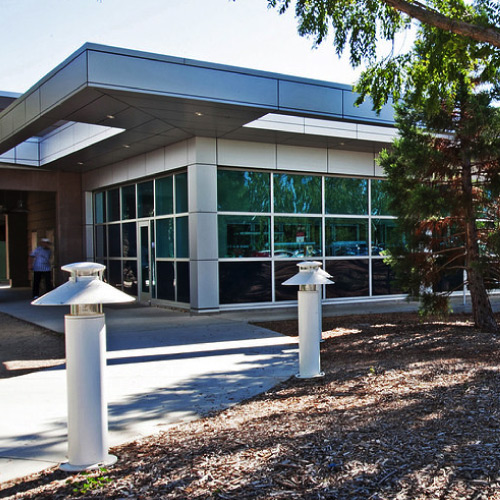
Department is part of the Science and Math Division located in the SM building
on the north side of the West Valley College campus.
Chemistry courses
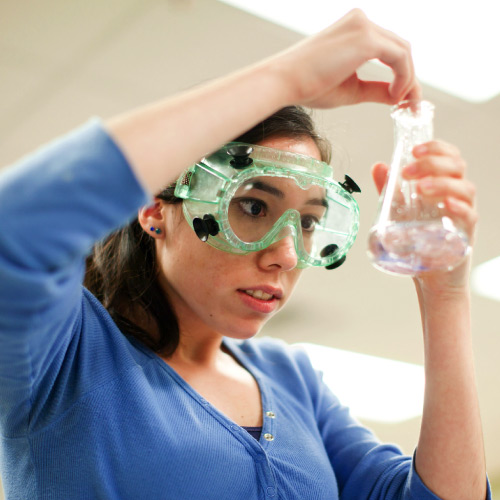
range from detailed major preparation to broad introductory courses. Laboratory
experiences make up an integral part of most of our courses. Throughout the
curriculum, the department emphasizes use of knowledge, rather than rote recognition
of specific terms and structures. We seek to develop critical thinking and foster
an awareness of the world of which we are a part.
Our courses meet
general education and transfer requirements in physical sciences. In addition,
courses can be taken to satisfy requirements for an Associate of Science degree
or transfer major requirements in chemistry, biochemistry, biology, nursing,
dental hygene, fire-science, chemical engineering, or a variety of pre-medical
areas.
Faculty (top of page) To access available web pages in support of
a course you are taking, or to e-mail faculty member please use these links.
Description
of Courses Offered (top of page) To access available
web pages in support of a course you are taking please use the links listed
by instructor.
Chem
1A - General Chemistry | Chem 1B - General
Chemistry | Chem 2 - Introductory Chemistry
Chem
5 - Quantitative Analysis | Chem 12A - Organic
Chemistry | Chem 12B - Organic Chemistry
Chem
30A - Fundamentals of Chemistry | Chem 30B - Fundamentals
of Chemistry | Chem 50 - Chemical Skills
| Chem 100 - Special Topics
- Lecture 3 hours;
lab 3 hours, recitation
Prerequisite: Chem2, or 1 yr. high school chemistry with a grade of
B or better and Math 106 or 106R, or 1 yr. high school algebra II. Concurrent
enrollment in Chem 50 strongly recommended.
- Acceptable
for credit: University of California, California State University
Emphasis on the understanding and applications of the principles of theoretical
and structural chemistry.The nature of matter and the changes it undergoes
are stressed qualitatively and quantitatively in lecture and laboratory. (CAN
CHEM 2)
- Lecture 3 hours;
lab 3 hours, recitation 1 hour
Prerequisite: Chem 1A
- Acceptable
for credit: University of California, California State University
A continuation of Chemistry 1A. The units of study will include solution equilibria,
thermodynamics, coordination compounds, and kinetics. The laboratory will
consist of qualitative analysis of cations and anions and the synthesis of
some specific compounds. (CAN CHEM 4)
Chemistry
2 - Introductory Chemistry (4 units) (back)
Lecture 3 hours;
lab 3 hours
Prerequisite: Math 106 or 106R or 1 yr. high school algebra II
Acceptable for credit: University of California, California State University
Introduction to fundamental principles of chemistry, including atomic theory,
chemical bonding, molecular structure, chemical reactions, stoichiometry,
gas laws, and solution chemistry. The course stresses problem solving and
is designed specifically to prepare the student for Chemistry 1A.
- Lecture 2 hours;
lab 6 hours
Prerequisite: Chem 1B
- Acceptable
for credit: University of California, California State University
The theory and practice of gravimetric and volumetric analysis, electrochemistry
and instrumental methods will be discussed. The analysis of unknown samples
by both classical and instrumental techniques will be undertaken.
- Lecture 3 hours;lab
6 hours
Prerequisite: Chem 1B
- Acceptable
for credit: University of California, California State University
A study of the fundamentals of organic chemistry with emphasis on underlying
concepts. Modern laboratory techniques, including instrumental methods of
structure determination. Recommended for chemistry majors, chemical engineering
majors, most biology majors, and for pre-medical and pre-dental students.
- Lecture 3 hours;
lab 6 hours
Prerequisite: Chem 12A
- Acceptable
for credit: University of California, California State University
A continuation of Chemistry 12A.
- Lecture 2 hours;
lab 3 hours
- Prerequisite:
Math 103 or 103R or 1 yr. of high school Algebra
Acceptable for credit: University of California, California State University
An elementary course covering the basic principles of inorganic chemistry
and an introduction to organic chemistry. For non-science majors. Especially
designed for the RN candidate and majors in the following four-year programs:
Physical Education, Administration of Justice, Psychology, Sociology, Dental
Hygiene, and Home Economics (except Dietetics). Not recommended for science
majors. (CAN CHEM 6)
- Lecture 2 hours;
lab 3 hours
Prerequisite: Chem 30A
- Acceptable
for credit: University of California, California State University
A continuation of Chemistry 30A with emphasis in the fields of organic and
introductory biochemistry.
- Laboratory
3 hours by arrangement.
Strongly recommended for students below the minimum assessment levels for
Chem 1A.
- This course
is designed to strengthen the basic skills requred in Chem 1A. Included will
be units from mathematics, measurement, chemical formulas, chemical equations,
ahd chemical problem solving. Credt/No Credit Option.
Chemistry
100 - Special Topics (.5-3 units) (back)
Lecture and/or
lab .5 to 9 hours
The course will explore topics related to this descipline and will be offered
as needed. See the class schedule for current offerings. Credt/No Credit Option.
Schedule
of Classes (via College Web Page) (top of page)
Revised 15 August
2001
|