
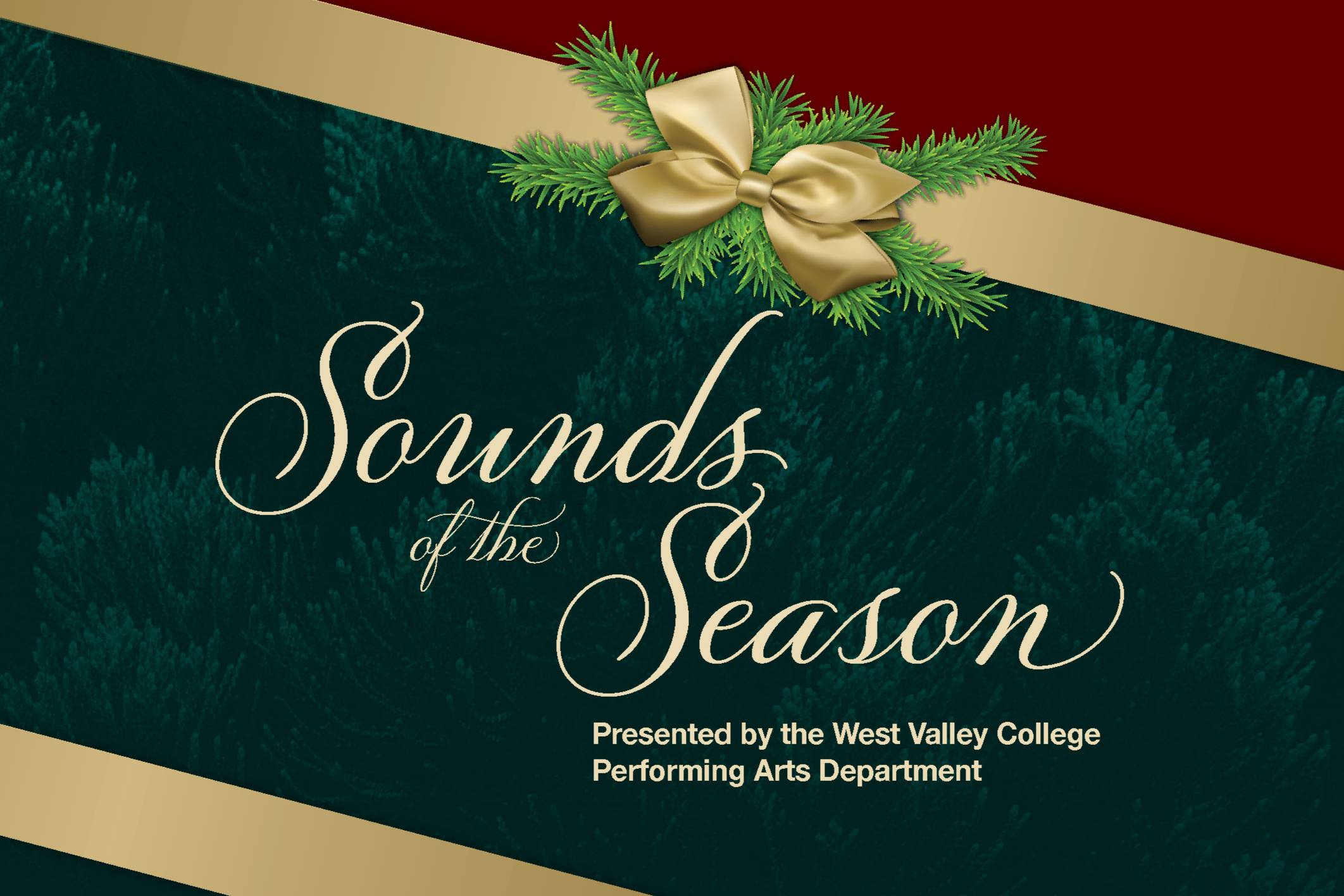
Gather with friends and family for Sounds of the Season! West Valley College Performing Arts invites you to share in the joy of music and community during this special holiday celebration. Join us on Friday, December 5 at 8 p.m. This event will be off-campus, located at the St. Andrews Episcopal Church.
Featuring:
- West Valley College Concert Choir
- Lou De La Rosa, Conductor
- Special Guests Mtn. View High School Madrigals
- Jill Denny, Conductor
Complimentary parking available on-site.
Program Notes
Read the stories behind the music.
The music of San Francisco composer Kirke Mechem, who turned 100 this year, is performed worldwide, and valued for its tonality, clever harmonies, and above all, its tunefulness. In honor of Kirke’s longevity, we performed Blow Ye the Trumpets from his opera John Brown earlier this semester. We offer these two short songs from 1987 that reach back to the cantatas of Bach for their form, and forward to today’s harmonies: with poetry by G.K. Chesterton (1874-1936) and Mechem himself (b.1925).
The Christ-child lay on Mary’s lap, His hair was like a light.
O, weary, weary were the world, But here is all aright.
The Christ-child lay on Mary’s breast, His hair was like a star.
O stern and cunning are the kings, But here the true hearts are.
The Christ-child lay on Mary’s heart, His hair was like a fire.
O, weary, weary is the world, But here the world’s desire.
The Christ-child stood at Mary’s knee, His hair was like a crown,
And all the flowers looked up at Him And all the stars looked down.
Snowfall turns the earth to white, Day grows into quiet night.
Overhead a star appears, Changeless through the changing years.
Voices rise in song again: “Peace on earth, goodwill toward men.”
Everlasting star above, Help us find that peace and love.
Two lovely eyes have twisted my heart and if I do not beg for mercy,
To those lovely eyes, for those, yes for those I would die of love.
Translation by L. De La Rosa
In 1942, American composer Irving Fine composed incidental music for a production of Lewis Carroll's Alice in Wonderland, and later that year, drew from the score three separate works for chorus and piano: "The Lobster Quadrille," "The Lullaby of the Duchess," and "Father William."
Alice in Wonderland can be interpreted in several ways, most commonly as a journey of growing up and a quest for identity, representing the transition from childhood to adulthood and the struggle to navigate the illogical rules of the adult world. It also symbolizes the power of imagination and creativity, the importance of individual logic in a world of absurdity, and a critique of rigid Victorian-era society.
This Lewis Carroll poem within Alice in Wonderland is a parody on a then well-known poem The Old Man's Comforts and How He Gained Them by Robert Southey, imitating its poetic meter verbatim. That poem responded to a young man’s questions about aging with reason, patience, and perspective, quite the opposite of Lewis Carroll’s lyrics.
Song from William Shakespeare’s As You Like It, Act 2, Scene 7. In the play, Amiens, laments the unjust dismissal from court of Duke Senior and his followers due to his brother’s betrayal. He compares the faithlessness of a friend to the cold bite of Winter and deems ingratitude and feigned friendship worse than Winter’s freeze. It is up to the listener to decide whether “This life is most jolly” to be a sarcastic remark, or a decision to enjoy life despite the occasional betrayals of others.
Pastorcito santo by Lope de Vega
Oh, if the palm tree but knew that a star had fallen from heaven for the Child asleep in the stable, green leaves t’would offer to fan him, lulling the Child in its cradle.
Happily, down from the mountain, the shepherd boy on his donkey is riding on to the stable! Hurry the infant is waiting, this Christmas evening’s soon over.
In Bethlehem, the pure Virgin prays to the Child who is waiting.
Mary the Virgin is singing, the Child at her sweetly smiling, how sad the palm tree is waving! Oh, if the palm tree but knew now what was coming….
The Little Drummer Boy has been a favorite American carol for several decades, but has a storied past including a title change, and specious songwriting credits. The melody to the original Carol of the Drum with words and music by Katherine K. Davis was credited by the composer as based on a Czech composition. It was published in 1941, recorded in 1951 by the Trapp Family of The Sound of Music fame, and the sheet music was published by Belwin-Mills.
However, the song truly became a Christmas favorite with a new setting in a 1958 recording by the Harry Simeone Chorale under the new name as given tonight. Connections to major recording studios allowed Harry Simeone and Harry Onorati to share songwriting credits with Katherine K. Davis, rather than being listed simply as arrangers, yet the work of another arranger, Jack Halloran, upon whose arrangement this version is largely based, was completely omitted.
Using a rhythmic ostinato to unify the work, Toby Young provides an energetic a cappella setting of a Jennifer Thorpe text that celebrates the festivities of the Christmas season.
Composer Kevin Memley wrote, “Ave Maria was written for the Clovis East High School Timberwolf Chorus, one of several choirs I accompany in Central California. We premiered the work in Carnegie Hall in April 2008. It was written in 2007, and quite oddly was input directly into a computer—I have no hand-written draft. I mention this only because as of late, I have become attached to good old-fashioned pencil and paper and truly enjoy the feel of the composition process at the piano. The ‘cascading waterfall’ effect and the few pages of rhythms are meant to provide nothing more than a palette of colors to support the melody.”
Sung in Hebrew with a traditional Jewish tune, Ani Ma Amin is a statement of faith and hope with text from the 13 Principles of Faith as given by Maimonides who stressed the belief that there is one single, omniscient, transcendent God who created the universe and continues to interact with his creation.
The song Ya Rajaee translated from Arabic as 'My Hope' expresses a deep spiritual connection and reliance on a higher power for guidance and forgiveness. The lyrics convey a sense of seeking solace and strength in times of darkness and uncertainty, symbolized by metaphors like seeking light, quenching thirst, and persevering through challenges.
This Nigerian Christmas carol is sung in the original Yoruba:
We rejoice for we have a trustworthy Father. We rejoice for we have a dependable Father. Where was Jesus born? Where was He born? In Bethlehem, city of wonder. That is where the Father was born for sure. Praise, praise, praise be to him. We thank Thee for this day. Gracious Father.
Commissioned in memory of a choral singer and clarinetist, George Olin, this 2021 arrangement of the well-known hymn tune, Lobe den Herrn (Praise to the Lord), has been set by composers for hundreds of years, most notably J.S. Bach in his Cantata of the same name, BWV 137. The melody was likely a secular folk tune that was brought into a sacred setting, initially published in a 1665 German hymnal. It is set by American composer Susan La Barr (b. 1981) with a new text written by poet Charles Anthony Silvestri (b. 1965).
Praise for the sun, who by day gives us warmth and enlightens;
Praise for the moon, who the darkest night cheerfully brightens;
Each glitt’ring star shining from ages afar,
Driving away all that frightens.
Praise for the sky under heaven that widely contains us;
Our fertile earth, and her harvest that gently sustains us;
Birds on the wing, lifting their voices to sing,
Free us from all that restrains us.
Our tender hearts, which so wondrously in chambers deeping,
(Can) cherish the joys of new love and, at death’s call, the weeping.
Sorrow and pain turn to rejoicing again;
Love now in memory keeping.
Praise for this joy in our hearts as we sing of creation!
Wondrous are all things from firmament down to foundation!
Joyful our praise as all our voices we raise,
Singing in glad celebration!
Composer Kendrick Tri Huynh is a graduate of West Valley College and San José State University. The WVC Chamber Singers premiered this work both here and in Europe in 2018. The text is by San José State University English Professor Emeritus Nils Petersen, Santa Clara County’s first Poet Laureate.
Snow falling white on white in a great shawling wind.
How can one see a snowflake then, no matter its pure and clean white shape?
Standing in a field of summer, each blade of grass willing its presence at you
And the myriad leaves of the far trees, each sending you its own sign,
And the stars singing, invisible yet singing,
Beyond the blue shell, and the whisperings of last night’s dreams.
How much we must ignore, how much we need to praise it all!
Poem by James Agee (1909–1955)
Sure on this shining night Of star made shadows round,
Kindness must watch for me This side the ground.
The late year lies down the north. All is healed, all is health.
High summer holds the earth. Hearts all whole.
Sure on this shining night I weep for wonder
Wandering far alone Of shadows on the stars.
Dr. Brent Heisinger, Music Professor Emeritus of San José State University, has written a carol each year which he sends to friends on his Christmas card list. This one dates from the 1970’s.
Merry Christmas to you all with a bright and cheerful call. Heigh-oh! Let it ring, and echo bring!
Explore More from the WVC Performing Arts Department
View the Concert Program
Read the full program including a complete list of West Valley College student performers: Sounds of the Season digital program.
Upcoming Performances
Discover upcoming concerts, recitals, and theatre productions from the WVC Performing Arts Department: westvalley.edu/cilker-events.
Music Faculty
Learn more about WVC's outstanding, dedicated music faculty on the Music website.
Support the Arts at West Valley College
Your donation helps us provide students with access to high-quality instruments, performance opportunities, and professional mentorship: donate.wvm.edu/cilker-school-of-art-and-design.