
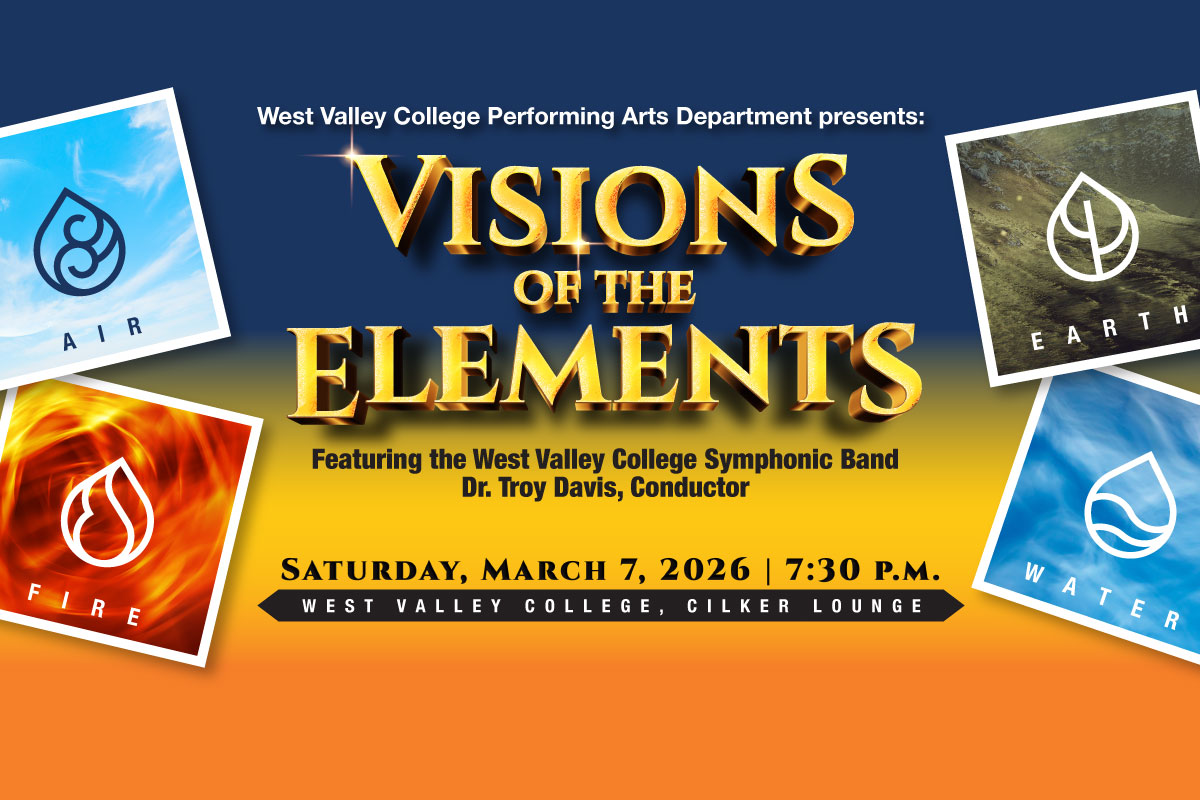
Through the art of telling stories through sound, the WVC Symphonic Band continues its Season of Sound & Story with a journey of meaningful music to entice our listeners and push our personal and collective boundaries. Visions of the Elements celebrates the five elements: earth, wind, water, wood, and fire and how they've been portrayed in sound.
Program Notes: The Stories Behind the Sound
The imagery of the lyrics describes the challenges of love: "Love is handsome, love is kind" during the novel honeymoon phase of any relationship. However, as time progresses, "love grows old, and waxes cold." Even true love, the lyrics say, can "fade away like morning dew."
César Chávez (1927-1993) was a Mexican-American civil rights activist and leader. Chávez co-founded the National Farm Workers Association, alongside Dolores Huerta. His enduring fight for equal rights and humane working conditions led the way for a nation-wide revolution. Among many recognitions, he was awarded the Presidential Medal of Freedom (1994).
This work explores quotes attributed to César Chávez. These quotes have endured time and paint a powerful picture into the mind of a father, husband, leader, activist, a revolutionary and American.
Each section of this work is represented by the following quotes:
"There's no turning back...we will win. We are winning because ours is a revolution of the mind and heart"
"We draw our strength from the despair in which we have been forced to live. We shall endure."
"The fight is never about grapes or lettuce. It is always about people."
"Preservation of one's own culture does not require contempt or disrespect for other culture."
"We cannot seek achievement for ourselves and forget about progress and prosperity for our community."
Reflections, hunger
"History will judge societies and governments, not by how big they are or how well they serve the rich and powerful, but by how effectively they respond to the needs of the poor and the helpless."
"Si, se puede!" Yes we can! – D. Huerta
"True worth is not measured in money or status or power. It is measured in the legacy we leave behind for those we love and those we inspire."
Deep space, planets, stars, and galaxies have inspired many artists over the centuries. How can one not start to dream when looking up at the enchanting show of shining immensity, an endless challenge for mankind? I have always been fascinated by the splendor of the universe; a passion that goes back to my roots, firmly anchored in the city of Toulouse (France), the cradle of some of Europe’s leading aerospace companies.
Aerospace is part of a huge project that has been very close my heart: the creation of a vast Symphony of Space for Symphonic Wind Orchestra and a number of choirs. Aerospace is the foundation stone of this edifice. It serves as a prelude, containing thematic material which is later fully explored in the rest of the symphony. The music unfolds with an amazingly wide variety of impressions: it reflects the time of the creation of the world, and little by little, the moon reveals its secrets and we are reminded of Neil Armstrong’s historic phrase. We try to penetrate the mysteries of the universe, as we gaze into infinity…
This piece was the winner of the first annual West Valley College Composition Competition. It was written by music major, Blix Carmona, who will be graduating this spring WVC music degree and transferring to university, where they will study composition.
Milhaud's Scaramouche, Op. 165b, takes its name not from the fictional character created by Rafael Sabatini, but from the Théâtre Scaramouche, headed by Henri Pascar. The Théâtre Scaramouche specialized in productions aimed at children; in May 1937 Milhaud contributed some music to Charles Vildrac's adaptation of Moliérè's Le medécin volant (The Flying Doctor). That same summer Milhaud was under pressure to produce a number of works for the Paris International Exposition; among them was a request for a piano duo for Marguerite Long and Milhaud's old friend Marcelle Meyer. Milhaud recycled two of the cues from Le medécin volant to form the outer movements of the suite, and for the slower middle movement extracted a piece written for Jules Superville's 1936 play Bolivar. The finished structure is as follows: 1. "Vif," 2. "Modéré," 3. "Brazileira" (Mouvement de Samba). Milhaud was quite facile at assembling pieces in this way, and was unnerved to note that the suite wasn't falling into place as easily as he'd hoped; Milhaud later remarked "it gave me enormous trouble."
Nonetheless, Scaramouche was ready in time for Marcelle Meyer and Marguerite Long to play it at the Paris Exposition. To Milhaud's dismay, it attracted immediate attention, and the publisher Deiss approached Milhaud with hopes of securing the rights. Milhaud at first resisted, thinking it too slight to merit publication, but Deiss persisted, and Milhaud finally caved in. A 78 rpm record of Meyer and Long playing Scaramouche was made and helped spread the word, and Meyer programmed the work at concerts given in Paris in 1943 during the German occupation.
As time went on, Scaramouche became something of a bête noire for Milhaud; it proved so popular over time that he found himself returning to it repeatedly in order to create new arrangements for publishers. The versions for clarinet and saxophone are best known apart from the original, but Scaramouche also exists in arrangements -- not all by Milhaud -- for concert band, wind sextet, chamber trio, three guitars, and even 16 saxophones. Jascha Heifetz transcribed "Modéré" and "Brazileira" for the violin; most unusually, the "Brazileira" was converted into a pop song, complete with added lyrics.
The bright, tumbling opening to "Vif" -- sometimes bitter with bi-tonal effects, yet strongly diatonic -- pricks up the ears right from the start; it resembles an out-of-tune Parisian street piano. The "Modéré" is graceful and understated, with a gentle, falling motion reminiscent of much popular music. The "Brazileira" is like an outtake from Milhaud's Saudades do Brasil of 1921, and is so close to that folk idiom that it could easily be mistaken for the "real" thing. Programmers of classical radio programs resort to the charms of the Scaramouche often; it grabs your attention, delivers the goods, and gets out the door -- all in just roughly ten minutes.
This particular arrangement utilizes the concert band as a whole, not as accompaniment to a particular soloist. In the first two movements, it also endeavors to reflect more child-like elements, from which the piece derives its title. In the first movement, energetic play and, in the second movement, a lullaby. The third movement is intended to emulate a Brazilian baion or batucata: a rather boisterous carnival street samba.
– Program Note by Uncle Dave Lewis (Allmusic.com) and the arranger
Starry Ocean is a musical journey that takes listeners deep into the depths of the ocean, capturing the alluring spectacle of marine life as it mirrors the mystical allure of a star-filled sky. The narrative in the music seeks to depict the enchanting undersea landscape that resembles Van Gogh's "Starry Night." The peace begins with a tranquil, serene depiction of the undersea world, gradually building in complexity as the marine life becomes more active and vibrant. The music reflects this flurry of activity within this undersea cosmos, creating a soundscape that is as intriguing as the bioluminescent creatures in the deep ocean.
Originally from China, Shuying holds degrees from the University of Michigan and the Hartt School. A passionate educator, Shuying has taught and directed the Composition/ Music Theory Program at Gonzaga University. She joined the faculty as the Assistant Professor of Music at California State University, Sacramento, in Fall 2022. Shuying is the founder and artistic director of the contemporary ensemble and non-profit organization Four Corners Ensemble and its annual festival, Operation Opera. For more information, please visit http://www.shuyingli.com.
El Camino Real (literally "The Royal Road" or "The King's Highway") was commissioned by, and is dedicated to, the 581st Air Force Band (AFRES) and its commander, Lt. Col. Ray E. Toler. Composed during the latter half of 1984 and completed in early '85, it bears the subtitle "A Latin Fantasy."
The music is based on a series of chord progressions common to countless generations of Spanish flamenco (and other) guitarists, whose fiery style and brilliant playing have captivated millions of music lovers throughout the world. These progressions and the resulting key relationships have become practically synonymous with what we feel to be the true Spanish idiom. Together with the folk melodies they have underscored, in part derived by a procedure known to musicians as the "melodizing of harmony," they have created a vast body of what most people would consider authentic Spanish music.
The first section of the music is based upon the dance form known as the Jota, while the second, contrasting section is derived from the Fandango, but here altered considerably in both time and tempo from its usual form. Overall, the music follows a tradition three-part pattern: fast-slow-fast.
The first public performance of El Camino Real took place on April 15th, 1985, in Sarasota, Florida, with the 581st Air Force Band under the direction of Lt. Col. Ray E. Toler.
Biographies
Troy Davis, Director of Instrumental Music & Jazz Studies | View Troy's Biography.

Maritza Spieller has been the instrumental music director at Evergreen Valley High School for seven years. Previously, she taught at Lawson Middle School in Cupertino, CA for five years. She grew up on the beach in Half Moon Bay, CA, went to Cal Poly in San Luis Obispo for her
undergraduate degree in Music and a focus in trombone performance. Maritza then went on to San Jose State University where she received her teaching credential and completed her student teaching at Homestead High School. She has now received her Masters of Music in Music Education from Michigan State University. Ms. Spieller is the sole director at Evergreen Valley High School running a 250 student program which includes; four concert bands, string orchestra, jazz ensembles, percussion ensemble, pep band, and a philharmonic orchestra.
Maritza continues to try to support our music education organizations having served as an Area Representative for her local CMEA chapter, moving on to be the recording secretary for that chapter, and is on her second term as President of the Santa Clara County Band Directors Association which has an honor band older than our All-State groups. She has also been a board member on the state California Orchestra Directors Association (CODA) board, now serving as their Communications Chair. Ms. Spieller has managed the All State Wind Symphony, All State Symphony Orchestra, and CODA Honors Symphony Orchestra as well as leading local clinics.
Explore More from the WVC Performing Arts Department
View the Concert Program
Read the full Visions of the Elements concert program including a complete list of West Valley College student performers: Visions of the Elements Program.
Upcoming Performances
Discover upcoming concerts, recitals, and theatre productions from the WVC Performing Arts Department: westvalley.edu/cilker-events.
Music Faculty
Learn more about WVC's outstanding, dedicated music faculty on the Music website.
Support the Arts at West Valley College
Your donation helps us provide students with access to high-quality instruments, performance opportunities, and professional mentorship. Select WV Instrumental Music in the Fund tab donate.wvm.edu/cilker-school-of-art-and-design.