

The West Valley College Academic Senate is the voice of all faculty, both full and part time, in the governance and decision-making processes of the college.
Charge
In accordance with Title 5 section 53203, the Academic Senate makes recommendations to the college and district on a wide range of academic and professional matters:
- Curriculum including establishing prerequisites and placing courses within disciplines.
- Degree and certificate requirements.
- Grading Policies
- Educational program development.
- Standards or policies regarding student preparation and success.
- District and college governance structures, as related to faculty roles.
- Faculty roles and involvement in accreditation processes, including self-study and annual reports.
- Policies for faculty professional development activities.
- Processes for program review.
- Processes for institutional planning and budget development.
- Other academic and professional matters as mutually agreed upon between the governing board and the academic senate.
Meetings
The Academic Senate relies on the collective wisdom and professional expertise of faculty to develop its recommendations, and all faculty are encouraged to become involved through participation in Academic Senate committees, communication with their division Senators, or attending Academic Senate meetings.
Meetings are held on the second and fourth Tuesdays of the month from 2:15 PM - 4:30 PM on Zoom or in-person in the Club Room.
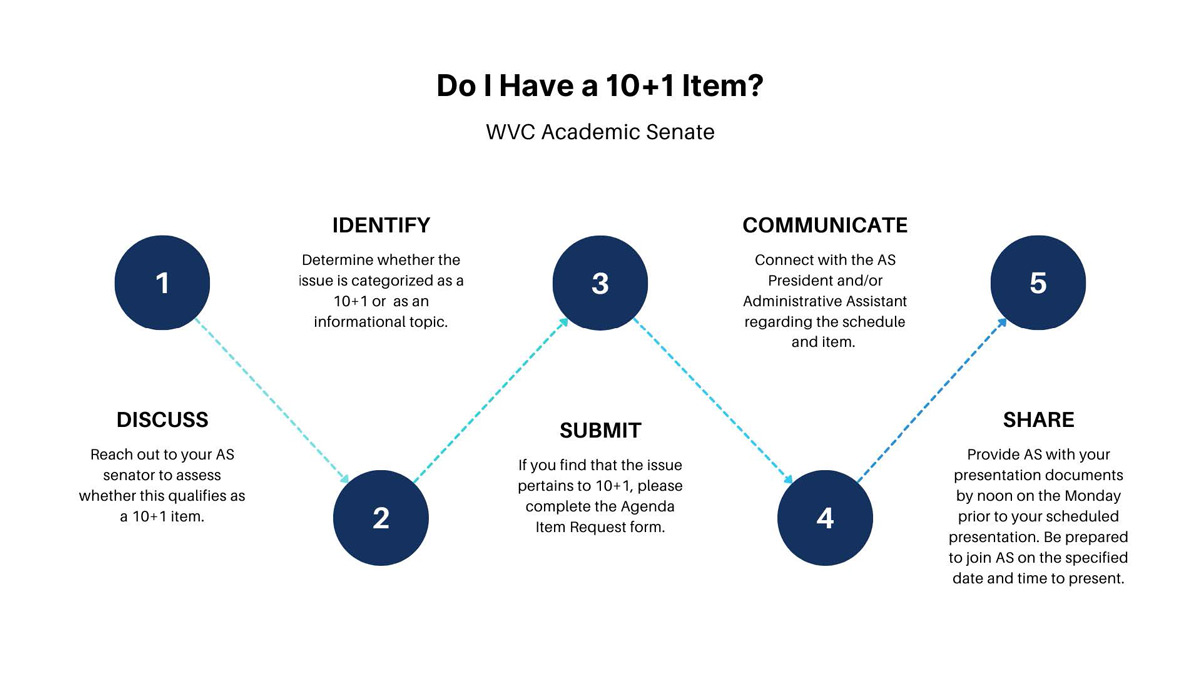
Agenda Item Request Process
Accessibility
The Academic Senate strives to make campus engagement and participation accessible to everyone and will provide reasonable accommodations upon request.
2026–2027 Academic Senate Meetings
The WVC Academic Senate meets on the second and fourth Tuesday of every month during the Fall and Spring semesters from 2:15 PM – 4:30 PM in the Campus Center Club Room (except where noted) and online via Zoom. Special meetings are as noted.
- September 8
- September 22
- October 13
- October 27
- November 10
- November 24
- December 8
- February 9
- February 23
- March 9
- March 23
- April 13
- April 27
- May 11
All Senate meetings are open to anyone who wishes to attend. The West Valley College Academic Senate is the voice of all faculty, both full and part time, in the governance and decision-making processes of the college. In accordance with Title 5 section 53203, the Academic Senate makes recommendations to the college and district on a wide range of academic and professional matters.
Senate Executive Team
| Name | Term | Position |
|---|---|---|
| Meg Farrell | June 2023 – June 2027 | Senate President |
| Jasmine Colon | June 2026 – June 2027 | Senate Vice President |
| Sharon Storm | Ongoing | Senate Assistant |
Senators
Senator Terms: Two years
| Name | Term | Position |
|---|---|---|
| Joe Bucher | September 2019 – June 2027 | Student Services |
| Jasmine Colon | January 2019 – June 2027 | Library |
| Laurie Dotson | September 2023 – June 2027 | Professional Studies |
| Scott Eitelgeorge, Alternating | September 2022 – June 2027 | Health and Human Development |
| Farima Fakoor | September 2021 – June 2027 | Associate Faculty Representative |
| Dan Fenstermacher | February 2024 – June 2027 | School of Art and Design |
| Michelle Francis | September 2023 - June 2027 | At-Large Representative |
| Lenore Harris | September 2026 – June 2027 | Language Arts |
| Tim Kelly | June 2005 – June 2027 | Social Science |
| Erika Llantero | October 2022 – June 2026 | Student Services |
| Faun Maddux | September 2019 – June 2027 | Science and Math |
| Brianna Moss | January 2026 – June 2027 | Associate Faculty Representative |
| Margaret Ortiz | September 2022 – June 2026 | Continuing Education |
| Christine Peters-Stanton | September 2023 – June 2027 | Science and Math |
| Cynthia Reiss | June 2008 – June 2027 | School of Art and Design |
| Paul Starks, Alternating | September 2023 – June 2027 | Health and Human Development |
| Ella Rae Petersen | September 2026 – May 2027 | Student Government Representative |
| Name | Term |
|---|---|
| Gretchen Ehlers | 2017 – 2023 |
| Eric Pape | 2013 – 2017 |
| Lance Shoemaker | 2009 – 2013 |
| Angelica Bangle | 2005 – 2009 |
| Vivian Lock | 2003 – 2005 |
| Linda King | 2001 – 2003 |
| Jim Wilczak | 1998 – 2001 |
| Joan Sarlo | 1996 – 1998 |
| Lydia Harris | 1995 – 1996 |
| Ed Lodi | 1994 – 1995 |
| Wanda Wong | 1993 – 1994 |
| Linda King | 1992 – 1993 |
| Fred Barnikel | 1991 – 1992 |
| Ed Lodi | 1989 – 1991 |
| Michael Herauf | 1987 – 1989 |
| Claudine Simpson | 1986 – 1987 |
Academic Senate's Role in Governance
Assembly Bill 1725 (1989), the last major California community college reform legislation, codified the concept of shared governance and required each district to implement the provisions of law within parameters established by regulation in Title V. The district's Board Policy 3.3.4, Academic Personnel, recognizes the role of the Academic Senate under the provisions of AB 1725 as codified in the California Code of Regulations, Title 5, 53200 and following. Board Policy 3.3.4b states, "It shall be the policy of the District to rely primarily upon the advice and judgment of the Academic Senate in all eleven areas identified in the California Code of Regulations, Title 5 # 53200." Board Policy also states, "The recommendations of the Senate will normally be accepted, and only in exceptional circumstances and for compelling reasons will recommendations not be accepted. If the recommendation is not accepted, the Board or its designee, upon request of the Academic Senate, shall promptly communicate its reasons in writing to the Academic Senate."
Academic Senate Purview
- Curriculum, including establishing prerequisites.
- Degree and certificate requirements.
- Grading policies.
- Educational program development.
- Standards or policies regarding student preparation and success.
- College governance structures, as related to faculty roles.
- Faculty roles and involvement in accreditation processes.
- Policies for faculty professional development activities.
- Processes for program review.
- Processes for institutional planning and budget development.
- Other academic and professional matters as mutually agreed upon.
Academic Senate Constitution
- Curriculum, including establishing prerequisites
- Degree and certificate requirements
- Grading policies
- Educational program development
- Standards or policies regarding student preparation and success
- College governance structures, as related to faculty roles
- Faculty roles and involvement in accreditation processes
- Policies for faculty professional development activities
- Processes for program review
- Processes for institutional planning and budget development
- Other academic and professional matters as mutually agreed upon
When appropriate, the West Valley Academic Senate as a body will work in cooperation with the Mission College Academic Senate on district-wide issues through the District Academic Senate; and it will maintain its sovereignty as the representative body for the WVC faculty during any and all District Academic Senate meetings.
Section 1
Membership in the Academic Senate shall be open to currently employed Faculty Members, including Regular Faculty, Contract Faculty, and Associate Faculty.
Section 2
The Academic Senate shall be composed of:
- One full-time faculty member selected by his/her peers from each division/school as defined by the Academic Senate in conjunction with the existing organizational structure of the college.
- When a division has more than 20 full-time faculty members, that division shall have two elected full-time faculty to serve on the Academic Senate.
- One full-time faculty member from the Library or other non-instructional area excluding student services.
- Two full-time faculty members from the Student Services Division, one from Counseling and one from Support Services.
- One full-time faculty member elected at large.
- One full-time faculty member from the School of Continuing Education.
- Two Associate faculty members elected at large by a majority of the Associate Faculty members who vote. In the event of an uncontested seat, the Academic Senate may, in lieu of holding an election, appoint the eligible, nominated candidate.
- The Academic Senate President elected by the full-time faculty membership.
- One full-time faculty member elected by a majority of faculty to serve as President-elect in the second semester of the second year of the president’s two-year term.
- One student representative selected by the Associated Student Body for a one year term shall have an advisory vote.
Section 3
The term of membership shall be as follows:
- The president shall serve for a two-year term beginning June 1st.
- The president-elect shall serve for a one semester term during the second year of the president’s two-year term of office.
- Senators of the Academic Senate shall serve for a two-year term, beginning at the start of the academic year. Members may be elected to serve additional terms.
- Senators may be recalled by a majority vote of the constituency that elected them.
- If an Associate Faculty Senator no longer has an assignment during his/her term of office, an election will be held for a replacement to complete the term.
- Vacancies will be filled immediately by special election within the represented areas.
- If a Presidential vacancy occurs during the first year of the president’s term, the vice president will serve only until the end of that academic year, at which time a new president shall be elected by the membership to serve for a two-year term.
Section 1: President
The President of the Academic Senate is elected by full time faculty membership during October of the year prior. The President shall assume the responsibilities on June 1st and serve for two academic years. The President is expected to:
- Assume the responsibilities on June 1st and serve for two academic years.
- Provide initiative in identifying and pursuing professional and academic issues and engage in ongoing discussions with faculty and administrators on these issues.
- Attend college and district-wide participatory governance committees and councils to ensure the primacy of faculty on academic and professional matters and the efficient completion of tasks.
- Work to ensure that old and new business items on Academic Senate meeting agendas are focused on academic and professional matters within the Academic Senate’s 10+1 purview.
- Seek Academic Senate direction and serve as the representative, spokesperson, and advisor to the college or district on the senate’s position regarding academic and professional matters.
- Be available for 1:1 meetings with faculty, classified staff, and administrators and for 10+1 group mediations to assist both parties in negotiating resolutions of issues and/or conflicts.
- Work to resolve concerns of individual faculty members or to refer faculty members to the union on matters of wages or working conditions and/or to appropriate administrator(s).
- Serve as the representative of the Academic Senate over summer and winter breaks and, with Academic Senate pre-approval, make decisions on behalf of the Academic Senate as needed.
- Consult with Department Chairs or Committee Chairs regarding hiring committee composition.
- Facilitate ongoing communication, exchange of information, and leadership collaboration between Academic Senate Standing Committee Chairs.
- Train senators and standing committee chairs on 10+1 purview, open meetings act, Robert’s Rules of Order, and related legislation (Title 5, Education Code, Administrative Procedures).
- Attend and participate in the fall and spring State Academic Senate Plenary sessions, assuming the role of official voting delegate at these sessions, and the related Area Pre-session meetings.
- Approve documents or invoke the right to refuse to sign if documents are incomplete or proffered in circumvention of the established process.
- Work to ensure that classified staff and students have a voice during Academic Senate meetings.
- Preside over Academic Senate meetings using Robert’s Rules of Order decision-making and in compliance with Open Meetings Act to include ensuring that agendas are submitted 72 hours in advance and agenda items are designated as Information (I), Discussion (D), and/or Action (A).
- Serve as co-chairperson of the District Academic Senate and co-facilitate meetings, as necessary.
- Vote at Academic Senate meetings only in case of a tie to break that tie vote.
- Encourage the maintenance and accuracy of the Academic Senate constitution and website.
Section 2: Vice President
Each April, the Academic Senate selects the Vice President from its members. The Vice President’s term of service begins in June and ends in May of the following academic year. The Vice President is expected to:
- Serve for one academic year.
- Substitute for the President in their absence and assist in any or all duties/responsibilities of the President.
- Maintain full voting privileges at Academic Senate meetings.
- Serve as the District Academic Senate co-chairperson if an Academic Senate President cannot.
- Meet bi-monthly with the President and Administrative Assistant.
- Attend Academic Senate for California Community Colleges (ASCCC) events as able, such as the fall and spring Plenaries and leadership conferences, to inform their understanding of the role of statewide and local Academic Senates.
- Attend Academic Senate-related college and/or district-wide committee meetings or councils each month to represent the Academic Senate’s position and to enhance faculty presence.
- Work to improve communication and/or encourage collaboration between the Academic Senate and the Student Senate, the Classified Senate, the faculty, and/or the administration.
- Be familiar with Education Code, 10+1 powers and purview, Title 5, Brown Act, Roberts Rules of Order, and ASCCC resolutions and how they relate to the legislative nature of the local and statewide academic senates.
Section 3: Senators
Senators are elected by their constituents and serve two-year terms. Senators are expected to:
- Represent the constituents of their respective areas and their interests. The Senator At-Large will represent all faculty, including those not falling within one of the following areas, each of which will have a senator/representative:
- Academic Areas/Divisions
- Library and Learning Services
- Student Services Division
- Associate Faculty
- Attend all regularly scheduled Academic Senate meetings in compliance with Brown Act requirements and following Robert’s Rules of Order decision-making processes.
- Participate in ad hoc committees, work groups, Academic Senate Standing Committees, and/or task forces as set forth by the Academic Senate and/or District Academic Senate.
- Effectively communicate between their constituents and the Academic Senate.
- Familiarize themselves with Education Code and Title 5 and how they relate to participatory governance and the legislative nature of the Academic Senate.
- Educate their constituents concerning the 10 + 1 legislative functions of the Academic Senate as needed.
Section 1
The functions of the Academic Senate shall be to:
- Serve as the official representative body of the faculty of West Valley College on academic and professional matters.
- Make recommendations to the college President and other officials of the college regarding educational policies, procedures, curriculum and other professional matters as specified in AB 1725.
- Appoint all faculty members to serve on district or college-wide participatory governance committees that require faculty representation, except those committees whose membership is selected by the faculty union. The appointed committee members shall be responsible to and shall maintain communication with the Academic Senate.
- Establish such standing, special, or ad hoc committees that the Academic Senate deems necessary to adequately participate in the formation of college policies on academic and professional matters.
- Standing Committees of the Academic Senate including dormant committees:
- Curriculum Committee
- Professional Development Committee
- Distance Education Committee
- Global Education Committee
- Student Learning and Program Effectiveness Committee
- Work in cooperation with the Mission College Academic Senate to promote effective communication between the two colleges and achieve common goals.
- Participate in the shared governance plan structure.
Section 1: Enactment
This constitution and by-laws will be effective following adoption by a simple majority of those West Valley College faculty members who vote. Officers elected at the first election after enactment of the constitution and by-laws shall serve their designated terms.
Section 2: Amendments
- A proposed amendment must be presented to the Academic Senate before such amendment is presented to the West Valley College Faculty.
- Proposed Amendments must be presented to the West Valley College Faculty in writing at least two weeks before a vote is scheduled.
- An amendment must be adopted by a simple majority of those West Valley College faculty members who vote.
Section 3: Interpretation of the Constitution and By-Laws
Interpretation of any sections of this constitution shall be made by a Senate committee composed of five (5) members of the Senate. The committee will include the President and the Vice-President if the issue does not concern them.
Academic Senate Bylaws
Section 1: Elections
- The election for President-elect shall be held in October of the second year of the current President’s term of office.
- Elections for one faculty member senator at-large shall be held in February and/or in coordination with the timeline for the development of the Fall class schedule for the following academic year.
- Election for Associate faculty members at-large shall be held in the last semester of the senator’s term.
- Each faculty member’s vote is to be counted as one (1) full vote.
Section 2: Committee Appointments
The Senate as a whole shall be involved in the recruitment and selection of committee appointments, including ad hoc, sub committees, task forces, etc., as needed throughout the academic year. These appointed committee members shall be responsible to and shall maintain communication with the Academic Senate.
Section 1: Regular Meetings and Agendas
The Academic Senate shall schedule and conduct a minimum of five (5) regular meetings per semester. Written agendas shall be distributed to all Faculty.
Section 2: Special Meetings
Special meetings may be called by the President or by the written request of 10% of the West Valley College Faculty. A written notice of a special meeting and its agenda shall be distributed by the President to all Faculty and a copy posted in each division office for Associate Faculty at least one day prior to the special meeting as required by the Brown Act.
Section 3: Minutes
The President shall be responsible for overseeing that the minutes of each meeting are recorded and distributed to all Faculty and a copy posted in each division office for Associate Faculty within two weeks.
Section 1
The Academic Senate is hereby empowered to make rules governing its own internal organization and procedures, subject to the following:
- A majority of the Academic Senate members (not including the student representative or Senate President) must be present to open a meeting and constitute a quorum.
- Any faculty member may attend any meeting and may speak to agenized items or present other issues of concern when recognized by the presiding officer.
- All actions or recommendations shall be made by majority vote of the Senators present. Should a senator be unable to attend a meeting, an alternate may be selected from his/her academic area. The alternate will assume full responsibility as the senator from that area. If an alternate does not attend, then the senator may submit a proxy vote on a given issue. Proxy votes will be honored. Voting procedures will be determined by the presiding officer unless two or more Senators request a roll-call vote.
- The Brown Act and Robert’s Rules of Order (latest edition) will guide procedures.
Interpretation of any sections of this constitution shall be made by a Senate committee composed of five (5) members of the Senate. The committee will include the President and the Vice-President if the issue does not concern them.
(NOTE: The West Valley College Academic Senate voted to incorporate the following academic freedom statement into its by-laws on March 16, 1993. With the exception of the first paragraph defining the scope of its coverage at West Valley-Mission Community College District, it is an almost verbatim rewrite of the California State University (CSU) system’s statement with the district name inserted where needed. The CSU statement on Academic Freedom is, in turn, substantially based on the 1940 AAUP Statement of Principles of Academic Freedom and Tenure, while their statement on Professional Ethics is an exact transcription of the 1966 AAUP Statement on Professional Ethics.)
Academic Freedom
Academic freedom in the pursuit and dissemination of knowledge through all media shall be maintained at the West Valley-Mission Community College District. Such freedom shall be recognized as a right of all members of the faculty, whether of tenure or nontenure rank, of all administrative officers, and of all students.
Academic Freedom and the Common Good
Academic institutions exist for the transmission of knowledge, the pursuit of truth, the development of students, and the general well-being of society. Free inquiry and free expression are indispensable to the attainment of these goals. Recognizing this, the West Valley-Mission Community College District exists to promote these purposes and the common good of the citizens of California and mankind and not to promote the welfare of an individual faculty, an individual department or college, or the institution as a whole.
The freedom of faculty to inquire, to teach, to speak, and to publish contributes very much more to the welfare of their fellow citizens outside the College than to their own good or the good of the campus. As a previous Chancellor of the California State University system, Glenn Dumke, said, the academic community has as one of its oldest functions to serve as “one of the consciences of society.” The academic community “is a questioner, a worrier, a critic, and idealist, seeking a better way toward human aspiration and fulfillment.” Academic freedom and tenure are essential for excellence in education and, moreover, exist so that society may have the benefits of objective and independent criticism, and honest answers to scientific, social and artistic questions that might otherwise be withheld for fear of offending an influential social group or transient social attitude.
On the most practical level many of the technological innovations of great material value to our society are the results of scientific research that is most effectively carried out in an atmosphere of complete academic freedom. On less tangible levels the social benefits of academic freedom are not so easily identified and accepted, but they are no less real than the material benefits. Free research, teaching, and discussion in political, social, and cultural freedom.
Society is best served when the teacher and the scholar feel free to criticize and advocate change in any theories and beliefs, however widely held, and in any existing social, political, and economic institutions. It is not easy for faculty to dissent and to advocate unpopular ideas; it is almost always to their personal disadvantage to do so; but it is to the advantage of society to encourage them; only thus will society be aware of the full range of social political and cultural choices available to it; and only thus can the democratic ideal be fulfilled.
Academic Freedom and Responsibility
It is recognized that faculty in the West Valley-Mission Community College District must defend and protect academic freedom - however unpleasant and costly to them personally. Earlier citizens of the State of California wisely established institutions of higher education in which the principles of academic freedom were respected; it is the responsibility of all faculty to conserve the integrity of these institutions at whatever sacrifice to their personal tranquility.
West Valley-Mission Community College District faculty have these further and related responsibilities: to maintain themselves as experts in their fields of competency by study, research, and, where appropriate, publication; to diffuse knowledge and, if possible, to encourage creativity by their teaching; to defend their colleagues and their institution against any threats to the exercise of their responsibilities, whether from within or without the West Valley-Mission Community College District.
From time to time in the history of higher education in California and elsewhere, advocates of particular social, moral, political, or aesthetic positions attempt by violence, lawlessness or political and social pressures to interfere with academic freedom. At such times, West Valley-Mission Community College District faculty have a special responsibility to see that their own actions do not interfere with the freedom of others. They have further responsibility to insist that their institution does not yield to ephemeral passion or heavy community pressures to take hasty actions that may infringe on freedom of expression.
Professional Ethics
Faculty, guided by a deep conviction of the worth and dignity of the advancement of knowledge, recognize the special responsibilities placed upon them. Their primary responsibility to their subject is to seek and to state the truth as they see it. To this end, faculty devote their energies to developing and improving their scholarly competence.
They accept the obligation to exercise critical self-discipline and judgment in using, extending, and transmitting knowledge. They practice intellectual honesty. Although faculty may follow subsidiary interests, these interests must never seriously hamper or compromise their freedom of inquiry.
As teachers, faculty encourage the free pursuit of learning in their students. They hold before them the best scholarly and ethical standards of their discipline. Faculty demonstrate respect for students as individuals and adhere to their proper roles as intellectual guides and counselors. Faculty make every reasonable effort to foster honest academic conduct and to assure that their evaluations of students reflect each student’s true merit. They respect the confidential nature of the relationship between faculty and student. They avoid any exploitation, harassment, or discriminatory treatment of students. They acknowledge significant academic or scholarly assistance from them. They protect their academic freedom.
As colleagues, faculty have obligations that derive from common membership in the community of scholars. Faculty do not discriminate against or harass colleagues. They respect and defend the free inquiry of associates. In the exchange of criticism and ideas, faculty show due respect for the opinions of others. Faculty acknowledge academic debt and strive to be objective in their professional judgment of colleagues. Faculty accept their share of faculty responsibilities for the governance of their institution.
As members of an academic institution, faculty seek above all to be effective teachers and scholars. Although faculty observe the state regulations of the institution, provided the regulations do not contravene academic freedom, they maintain their right to criticize and seek revision. Faculty give due regard to their paramount responsibilities within their institution in determining the amount and character of work done outside it. When considering the interruption or termination of their service, faculty recognize the effect of the decision upon the program of the institution and give due notice of their intentions.
As members of their community, faculty have the rights and obligations of other citizens. Faculty measure the urgency of these obligations in the light of their responsibilities to their subject, to their students, to their professions, and to their institutions. When they speak or act as private persons they avoid creating the impression of speaking or acting for their college or university. As citizens engaged in a profession that depends upon freedom for its health and integrity, faculty have a particular obligation to promote conditions of free inquiry and to further public understanding of academic freedom.